Ancient Olympics
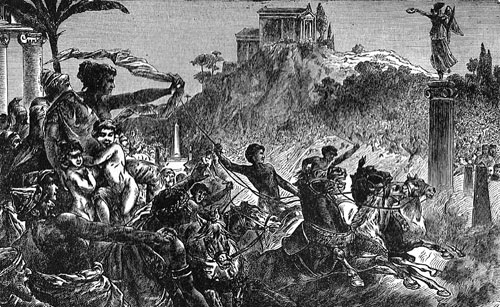
The first ancient Olympic Games were held in 776 BC. They began for religious purposes. The Greeks thought that holding these games would honor their gods. It’s hard to know exactly how the ancient Olympic Games were founded because there are also many myths. The ancient Olympics were exclusive, as only freed men could compete and primarily wealthy men would compete because they could afford training, gear, and etc.
The more wealthy and powerful you were, the more likely you were to win. Winning an ancient Olympic race would transform you into almost an immortal god. You were considered an idol and the rest of your life would be lived in glory. At the official award ceremony, (which was held on the last day of the games) winners would have their name called, their father’s name called, and their homeland called by the herald. The herald was like the judge. They would be given a wreath made of an olive branch to wear upon their head. They would also be awarded a statue of themselves.
Two famous ancient Olympians were Acanthus and Chionis of Sparta. The most famous race was the foot race, which was originally the only game held. As training went, an athlete trained with a trainer from the time he was a child. The three types of trainers were the paidotribes, the gymnastes, and the aleiptes. The physical trainers were called paidotribes. As the ancient Olympic Games evolved, more and more games became added. The games were held every four years just as the modern games are held now. The games were always held in Olympia.
As the ancient games evolved, more games became included. Here is a list some of the most prominent games that were held towards the end of the ancient Olympics: Boxing, Equestrian events, Chariot racing, Riding, Pentathlon, Discus, Javelin, Jump, Running, and Wrestling.
Modern Olympics
Pierre de Coubertin was the founder of the modern Olympics. The modern Olympics were founded in 1896. The first modern Olympic Games were held in Athens. Greece. They began because Coubertin thought that it would be a good opportunity for countries to glorify in a modest, non-violent way. The games are held every four years and winter games are held in-between, (every two years).
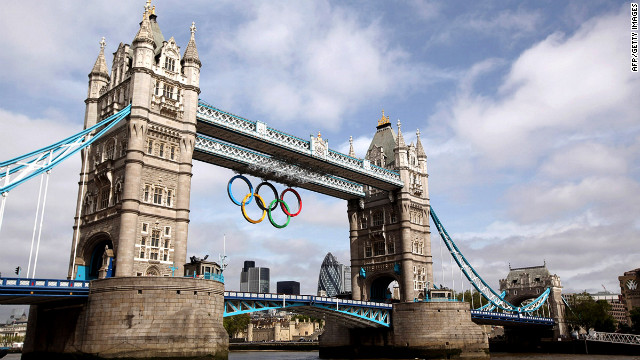
The Olympic committee decides where the games will be held. This year they were held in London and the next summer games will be held in Rio, Brazil in 2016. With all the technology, the ceremonies are epic and the Olympic Games aren’t just held to watch, but because of the amusement and astonishment that you’re experiencing. In the modern Olympics, there are LOTS and LOTS of games! I could make a list but it would almost seem infinite!
The Olympic emblem has five rings, representing the five major continents of the world, and the colors are red, yellow, blue, black, and green. These colors are important because at least one of them is present in the flag of every single country in the world.
The Olympic oath states that “We swear that we will take part in these Olympic Games in the true spirit of sportsmanship and that we will respect and abide by the rules which govern them for the glory of the sport and the honor of our country.” The idea of athletes taking an oath was first created by Pierre de Coubertin in 1906. The oath was first taken by an athlete in the 1920 Summer Olympics by the fencer/ water polo player, Victor Boin. The oath was first taken by an Olympic judge in the 1972 Winter Olympics by Fumio Asaki.
The Olympic motto is "Citius, Altius, Fortius." These words mean "Swifter, Higher, Stronger." The idea of a motto was proposed by Pierre de Coubertin in 1894. It was first used in the 1924 Olympic Games.
The Olympic creed, "The most important thing in the Olympic Games is not to win but to take part, just as the most important thing in life is not the triumph but the struggle. The essential thing is not to have conquered but to have fought well." is a quote by Pierre de Coubertin. This creed was inspired by a church service by Bishop Ethelbert Talbot.
The creed states, “The most important thing in the Olympic Games is not to win but to take part, just as the most important thing in life is not the triumph but the struggle. The essential thing is not to have conquered but to have fought well.” The motto is “swifter, higher, stronger” and it’s said before competition to build healthy attitudes. The Olympic Games encourage all countries to compete. People aren’t judged in the Olympics. The Olympics give average people the opportunity to make them proud, make their family proud, and make their country proud.
The creed, oath, and the motto were all created to build healthy attitudes and to make sure that the Olympians are staying true to their sportsmanship.
The difference between the summer and winter games are that the summer games are held every 4 years, and the winter are held every 4 years (either summer or winter Olympics every 2 years). The winter games clearly hold winter games such as snowboarding, skiing, etc. The summer games have many outdoor and indoor sports. Some are swimming, water polo, basketball, soccer, etc. There are 15 sports in the winter games, but about 26 in the summer games. Along with the medals, Olympic athletes are also given cash prizes: $25,000 for gold, $15,000 for silver, and $10,000 for bronze (the actual cash values of each medal are: gold-$675, silver-$385, and bronze- under $5).
The Olympic torch starts its journey in Olympia, Greece. The first modern Olympic torch relay was at the 1936 Berlin summer games. The torch takes about a year or two to build. It’s not just one torch that makes the entire journey; it’s around 10-15 thousand! A mirror (and the sun) was used to first light the torch in Olympia, Greece. The Olympic torch travels through the Olympic Torch Relay. In this event, many ordinary people are selected to be torch bearers. They each get the torch and bring it to the next torch bearer.